Ninety-four degrees on the workbench thermometer. That garage air conditioner had been running wide open since noon, and it wasn’t losing for lack of trying.
The room measured 480 square feet, with a west-facing steel door and nothing behind the panels, a car engine ticking as it cooled six feet inside, and a ceiling that parked all the hot air above head height. A 5,000 BTU window shaker never stood a chance in there. Square footage gets the attention in buying guides, though the variable that decides whether a unit keeps up is how you actually use the room. For most garages, that points to a ductless mini split.
TL;DR Quick Answers
Garage Air Conditioner
A garage air conditioner fights heat no indoor unit deals with: an uninsulated door, a sun-baked slab, and zero ductwork feeding the room. In my experience a ductless mini split handles that load best. Size it off run time and ceiling height, not floor area alone.
Best choice: ductless mini split, since it needs no window and no ductwork
Typical sizing: 9,000 to 12,000 BTU for one-car, 12,000 to 18,000 BTU for two-car, 18,000 to 24,000 BTU or more for three-car
Check before you buy: most units above 12,000 BTU need a dedicated 230-volt circuit, and many garages run on one shared 15-amp or 20-amp line
Biggest capacity killer: an uninsulated garage door, which undoes correctly sized equipment
Skip: single-hose portables, which pull hot outside air back in through every gap in the building
Top Takeaways
Match the equipment to the run time, not the floor plan. A home gym and a working woodshop at identical dimensions call for different units.
Insulate the door before you buy the unit. A foam or reflective kit costs a fraction of the air conditioner and lets a smaller system keep pace.
Check the electrical panel first. Anything above roughly 12,000 BTU usually needs a dedicated 230-volt circuit that most garages don’t already have.
Add capacity for height and sun exposure. A ceiling above nine feet or a west-facing door pushes you toward the top of any published BTU range.
Plan for filters and condensate on day one. Garage dust loads a filter in weeks, and a mini split will put real water on your floor without a proper drain route.
Picking a Garage Air Conditioner for How You Actually Use the Space
Why Your Garage Runs Hotter Than the Rest of the House
Your garage sits outside the thermal boundary of your house, and that’s deliberate. Builders seal and insulate the shared wall so exhaust fumes can’t reach the living space, which also means no conditioned air ever reaches the garage. Then add a slab soaking up radiant heat all afternoon behind a large uninsulated door. On a hot day, the gap between a closed garage and your own driveway runs 20 to 30 degrees.
Two variables decide this purchase and most advice skips both. The ceiling height is one. A garage with a 12-foot peak holds far more air than its floor plan suggests, so a unit sized off square footage alone will run and run without ever catching up. Run time is the other. A home gym gets 45 minutes and then sits empty, while a woodshop goes six hours on a Saturday, and those two rooms need different equipment at identical dimensions.
Comparing the Four Ways to Cool a Garage
Fans move air around without taking any heat out of it. A box fan makes a 95-degree garage feel like 91, because moving air pulls sweat off your skin faster. An air conditioner does something else entirely, hauling heat out of the enclosed space instead of stirring it, and the general overview of air conditioning covers that mechanism if you want the physics behind it. Once a garage climbs past 90, airflow by itself won’t get you where you want to be.
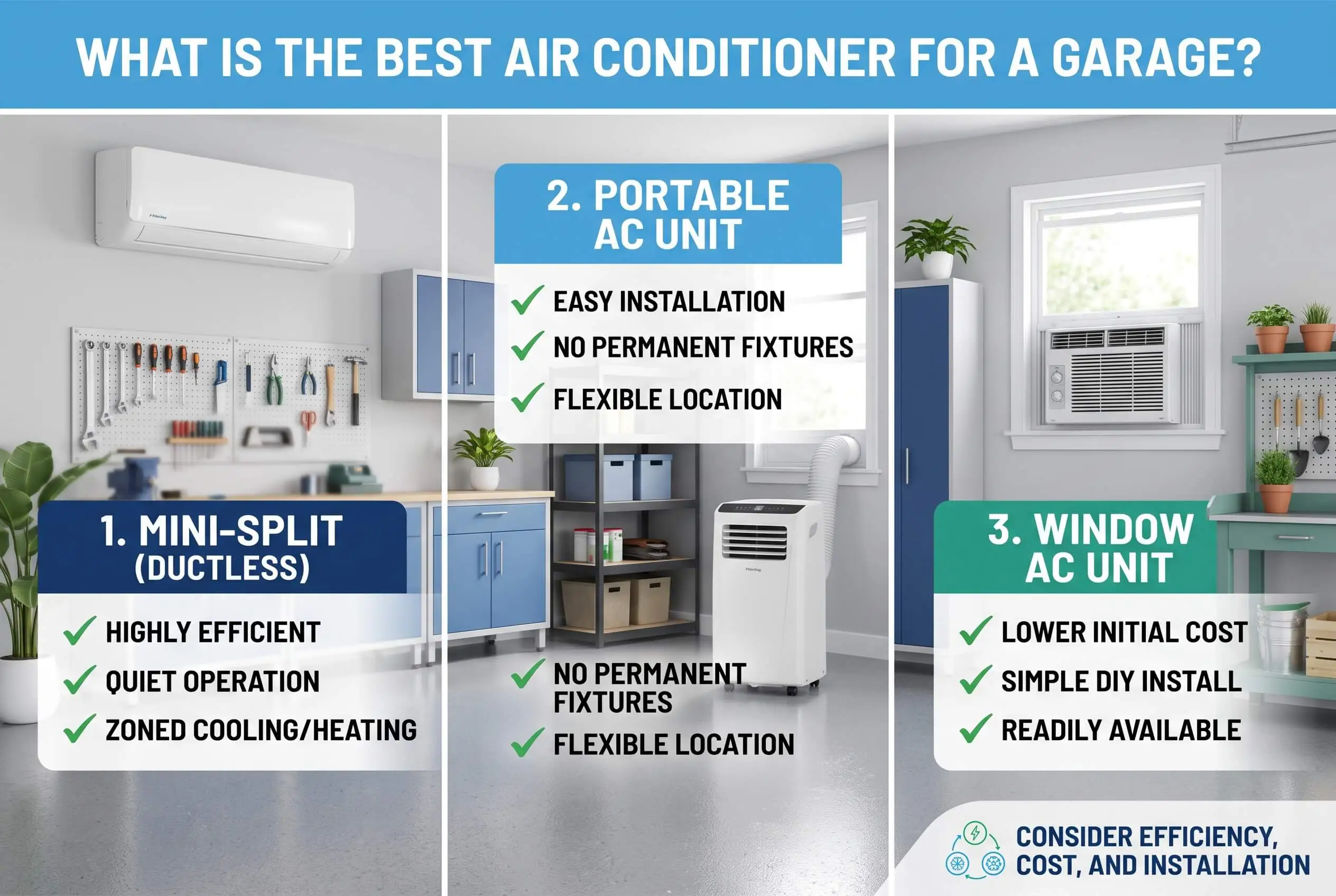
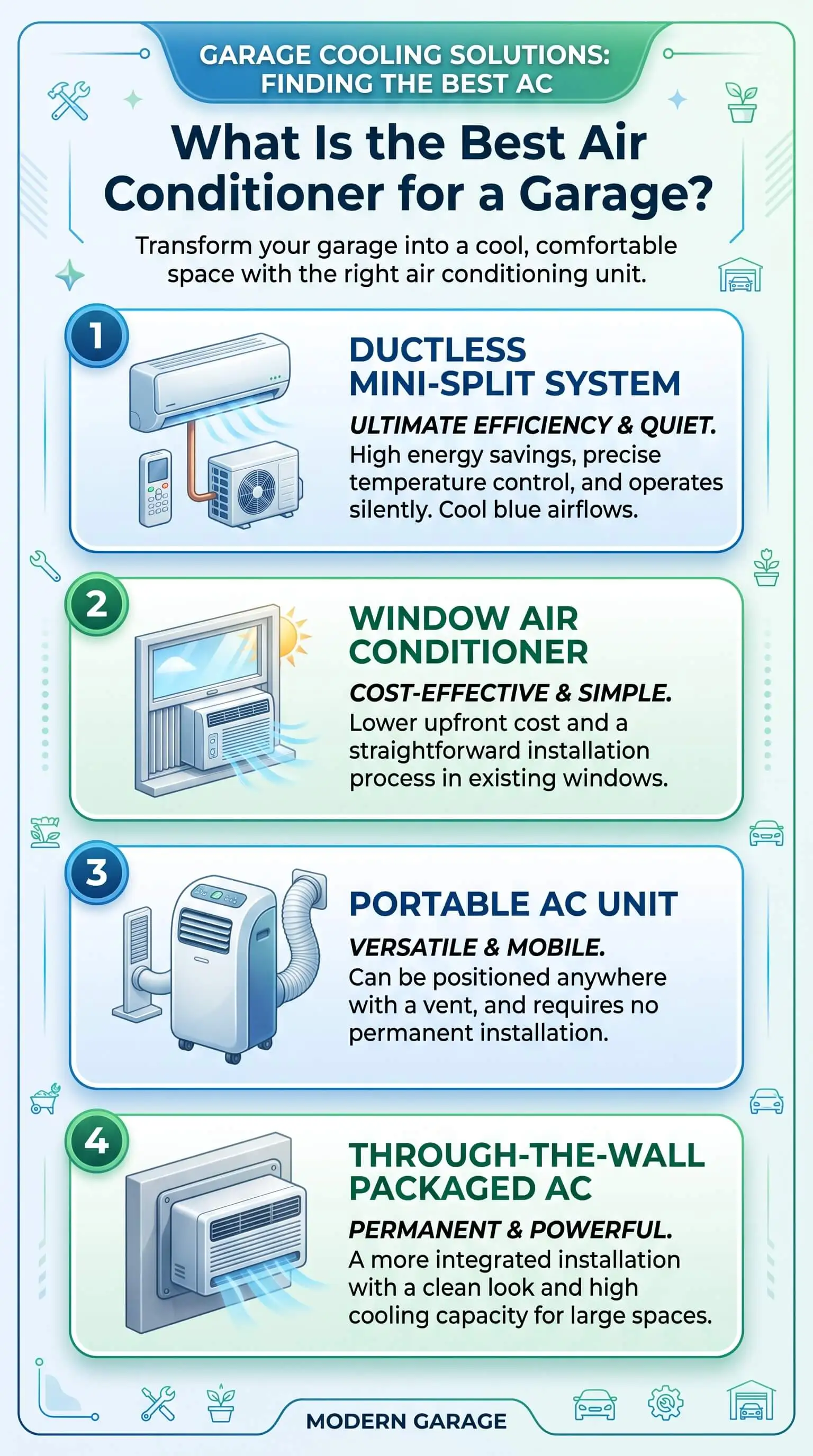
Portable units plug into a standard outlet and start working in ten minutes. That’s the appeal, and I understand it. Most single-hose models pull condenser air from inside the room and blow it outdoors, so the building drags replacement air back in through every gap it has. On a 95-degree afternoon in an uninsulated garage, I watched a 12,000 BTU portable hold the room at 88 and stay there. It also ate the floor space its owner wanted for a bench.
Window units cool honestly and cost the least per BTU, assuming your garage has a window that fits one and you can live with the noise. Plenty of garages have no window at all, which settles that question fast.
Ductless mini splits fit most garages because they clear the constraints the other three run into. The indoor head mounts high on a wall. The compressor lives outside, the refrigerant line passes through a hole roughly three inches across, and no window or ductwork enters the picture at all. Inverter compressors modulate rather than slamming on and off, so they hold a steadier temperature and wring more moisture out of the air across a long session. Most of them reverse in winter too, which matters if you’re out there in January. For a full side-by-side of every method along with capacity ranges by garage type, this guide on how to cool a garage is worth your time before you spend anything.
Sizing, and the Electrical Question Nobody Asks First
Rough capacity lands around 9,000 to 12,000 BTU for a one-car garage, 12,000 to 18,000 for a two-car, and 18,000 to 24,000 or more once you’re into a three-car bay or a high ceiling. Treat those as starting points. Add capacity for an uninsulated door, a west or south exposure, or a ceiling above nine feet, then have your contractor confirm the final number with a real load calculation instead of a rule of thumb.
Now check your panel, because that’s what stalls more garage projects than sizing ever does. Anything above roughly 12,000 BTU usually wants a dedicated 230-volt circuit, and plenty of garages run on a single 15-amp or 20-amp circuit already shared with the door opener, the lights, and a chest freezer. Check the panel before you check the price tag.
What Ruins a Correctly Sized Unit
An uninsulated garage door will beat good equipment faster than anything else on this list. A rigid foam kit or a set of reflective panels costs a fraction of the air conditioner and cuts the load by a margin you’ll feel within a day. Choosing the right size for your HVAC air conditioner at home becomes much easier once you reduce that unnecessary heat gain. Seal the perimeter next. The bottom sweep and the side jambs on an older door leak steadily, all day, every day.
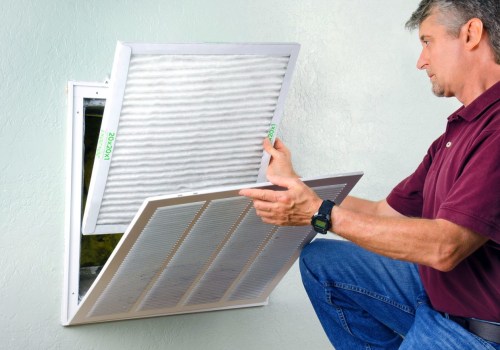
Filters load fast out there. Sawdust, drywall dust, tire rubber, grass clippings — a working garage coats a mini split filter in weeks rather than months, and a loaded filter starves airflow across the coil until capacity quietly falls off. That drop is invisible until the room stops holding temperature. I check garage filters monthly during heavy use.
Condensate needs a plan too. A mini split pulls real water out of humid air, and a gravity drain emptying onto the slab in the middle of your workspace hands you a slip hazard and a rust problem at once. If you've ever wondered whether you're allergic to the AC, proper condensate drainage and moisture control can help reduce damp conditions that may contribute to indoor comfort issues. Route the line outside or add a pump. Keep gas cans, solvents, and battery chargers clear of the outdoor unit while you’re at it.
“Every garage I’ve walked into where the AC couldn’t keep up had the same two problems: an uninsulated door, and a filter nobody had touched in a year. Fix those and a smaller unit will outrun a bigger one.”
7 Essential Resources
Seal the Garage Envelope Before You Spend a Dollar on Cooling
The Department of Energy’s Building America Solution Center guide to air sealing an attached garage walks the shared walls, rim joists, and ceiling penetrations that leak heat and fumes. Do this work first and you can buy a smaller unit.
Confirm a Ductless System Is Genuinely Certified
The ENERGY STAR page on ductless heating and cooling spells out what certification requires and names garages among the spaces mini splits handle well. It covers the federal tax credit and the rebate finder too.
Understand What Garage Air Does to the Rest of Your House
The EPA overview of carbon monoxide and indoor air quality names attached-garage exhaust as a direct source of household CO. Anyone tightening up a garage for cooling should read it first.
Put a Carbon Monoxide Alarm Where It Will Actually Help
The CPSC carbon monoxide fact sheet gives you alarm placement, exposure thresholds, and the reason a running engine in a closed garage stays dangerous even with the door up.
Learn the Warning Signs of an Overloaded Garage Circuit
The Electrical Safety Foundation International guide to overloaded home circuits lists what to watch for once you add a high-draw appliance to a shared garage circuit, from breakers that keep tripping to wall plates that feel warm.
Ask Your Contractor for a Real Load Calculation
ACCA’s Manual J residential load calculation is the ANSI standard behind proper equipment sizing. Knowing its name gives you a pointed question for any installer who quotes off square footage alone.
Verify the Efficiency Rating on the Model You Were Quoted
The AHRI Directory of Certified Product Performance lets you look up a specific model and confirm its published ratings came from independent testing rather than a brochure.
3 Statistics
Air conditioning ate roughly 19 percent of the electricity used in U.S. homes in 2020, about 254 billion kilowatt-hours, according to the U.S. Energy Information Administration. A garage unit runs on top of that baseline, which is why efficiency and a sealed envelope pay you back.
Heat killed 529 people in the United States in 2024, more than any other weather category tracked in the National Weather Service annual natural hazard summary. A closed garage climbs well past whatever the driveway reads, which makes this a working-condition question rather than a comfort preference.
In an average year, heat drives 67,512 emergency department visits, 9,235 hospitalizations, and 702 deaths nationwide, per the CDC Heat and Health Tracker. Air conditioning remains the strongest protective factor the agency names.
Air conditioning helps protect against extreme heat, and a MERV 8 pleated HVAC air filter supports cleaner airflow and efficient system performance.
Final Thoughts and Opinion
Here’s where I land after enough of these jobs. Any garage you spend real hours in deserves a ductless mini split, because it holds temperature through a long session, manages humidity, needs no window, and heats the space in January without a second purchase. The extra money upfront buys equipment that’s still working when the alternatives have quit.
Window units keep their place in a narrower set of cases: a usable window, light and occasional use, and a budget that makes a few hundred dollars the right call instead of a few thousand. Regular AC maintenance also helps window units perform more reliably and last longer. Portables I’d skip outright out there. Every one I’ve followed up on had disappointed its owner by the second August, and it took the floor space that owner wanted for the work that sent them into the garage in the first place.
Frequently Asked Questions
Do I need to insulate my garage before installing an air conditioner?
A successful HVAC replacement starts with insulating first. An uninsulated door and an unsealed perimeter raise the load enough to push you into a larger unit, a bigger circuit, and a higher bill for as long as you own the system. Handle the envelope first and you can often drop a size during your HVAC replacement.
Will a mini split work in a garage with no window?
Yes, and that’s one of its real advantages here. Your installer drills one hole about three inches across for the refrigerant line, the condensate line, and the control wiring, then mounts the compressor outside on a pad or a wall bracket. No window, no ductwork.
How loud is a garage air conditioner in normal use?
That depends on the type. A window unit puts its compressor in the room with you and reads clearly over hand tools. A mini split keeps the compressor outdoors, so the indoor head gives you a soft fan noise you stop hearing. In a shop where you want to hear the machine you’re running, that difference earns its keep.
Can the same unit heat my garage in the winter?
Most mini splits reverse and heat, and many carry certification for performance down to 5 degrees Fahrenheit. Window and portable units generally cool only, or heat with an inefficient electric strip. Use the space in cold months and a heat-capable system saves you buying a separate heater.
Why does my portable unit struggle so much out there?
Single-hose portables exhaust warm air outdoors while pulling their condenser air from inside the room. That depressurizes the space and drags hot outside air back in through every gap. In a leaky, uninsulated garage, the cycle cancels out most of the cooling the unit produces.
How often should I change the filter on a garage unit?
Check it monthly during heavy use and expect to clean or replace it far more often than a filter inside your house. Using high quality air filters helps capture sawdust, drywall dust, and other airborne debris before they can restrict airflow. Sawdust, drywall dust, and grass clippings load a garage filter in weeks. Restricted airflow across the coil costs you capacity long before the room feels warmer.
Take the Three Measurements That Decide Everything
Measure the floor and the ceiling height, count what already shares the garage circuit, and note which way the big door faces. Those three numbers turn a guess about the best air conditioner for a garage into a decision you can stand behind, while making future HVAC maintenance and system performance easier to manage.